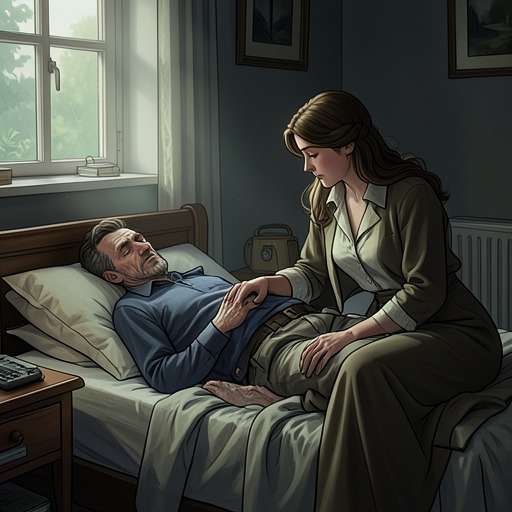
Constance Blackwood—Uncle Julian
We Have Always Lived in the CastleConstance Blackwood’s relationship with Julian Blackwood is one of practical, habitual care shaped by his illness and dependence. She feeds him, watches over him through difficult nights, and preserves his papers; he looks for her presence as much as for the food she brings. The relationship is tender but not effortless: Charles Blackwood disparages Julian’s needs, and Constance’s sense of responsibility turns into guilt over whether she has done enough.
A routine built around care
Constance’s care appears in small, repeated acts. When she sorts the groceries, she plans a soft egg, a muffin, and pudding for Julian, and gives particular attention to what he will eat. His needs are part of the household’s daily arrangements: while Mary Katherine Blackwood asks whether he may have peanut brittle, Constance says he can have it after lunch. The scene places care not in a grand declaration but in the decisions about timing, appetite, and suitable food.
His breakfast tray is equally particular. Constance brings hot milk in a jug painted with yellow daisies and trims his toast into small, hot squares, because large or difficult portions may be left uneaten. She takes the tray to his room every morning. Julian sleeps painfully and can lie awake waiting for the first light and for Constance to arrive; on other mornings, she brings him into the kitchen, where he sits at his old desk among his papers and crumbs. Her attention adapts to the fluctuations of his condition: when he is drowsy after taking an extra pill for his heart, he may not want the milk, but wants to know that she is nearby in the kitchen or garden.
That routine makes proximity itself part of the care. Julian’s dependence is not limited to receiving a meal: the knowledge that Constance is close offers comfort during the long morning and the darkness before it. Constance, in turn, organizes work around his needs, from preparing his tray to bringing him outdoors when he is well enough to sit in the sun.
Recognition and mutual dependence
Julian sometimes loses his bearings, and Constance responds by orienting him gently. When he mistakes her for Dorothy, she tells him, “You’re not Dorothy. You’re my niece Constance.” She also urges him to drink his hot milk. The exchange compresses their roles: Julian is vulnerable and confused, while Constance supplies both immediate physical care and reassurance about who she is to him.
His papers give the relationship another dimension. Julian is preoccupied with recording the family’s last day and completing his book; he calls the details important and says that he cannot afford to lose even a small one. His work gives Constance a role as the person who tends to him while he remembers and writes. At the same time, his insistence on keeping the papers away from Charles shows that his intellectual life and his need for privacy remain his own. Constance’s care does not erase his wishes: she helps him protect the papers rather than treating his dependence as permission to disregard them.
Charles’s interference and Constance’s burden
Charles’s arrival unsettles the established pattern. While he eats an abundant breakfast in the kitchen, Julian remains in his room with hot milk. When Julian calls for Constance, Charles tells her to say she is busy and mocks Julian’s need to be waited on, including his incontinence. The contrast exposes how differently the two men interpret care: for Constance, answering Julian is an ordinary responsibility; Charles treats it as needless indulgence and frames her labor as servitude.
The pressure becomes tangible when Mary Katherine asks Constance to make Julian a soft cake for lunch. Constance says she has too much to do, and Charles uses her workload to dismiss the request. Mary Katherine answers that Julian is going to die. In that exchange, Constance’s care is not withdrawn, but the work and competing demands around it are made visible. Charles’s presence interrupts the household rhythm and makes Constance’s attention to Julian seem, to him, an inconvenience rather than a relationship of obligation and affection.
Constance later tells Mary Katherine that Julian should be in a hospital and says, “This is all my fault.” Yet when the possibility is raised, she also says that putting him in a hospital would not be kind. Her hesitation reveals a conflict between recognizing that his needs may exceed what she can manage and believing that removing him from the familiar home would itself cause harm. She begins to say that she will have to send him, then stops and returns to preparing food. The unfinished thought leaves the burden unresolved: care demands both attention to his condition and a decision about what kind of help would serve him.
Death, memory, and the work that remains
After the house is wrecked, Constance and Mary Katherine return to the damaged kitchen. Amid broken dishes and scattered belongings, Constance asks what will happen to Julian; Mary Katherine tells her that there will be a funeral. The question shows that even in the immediate aftermath of the destruction, Constance’s attention remains directed toward him and toward the practical consequence of his death.
Once the sisters are settled, Constance opens and cleans Julian’s room. She washes his sheets and blankets in the kitchen sink and sets them outside to dry. Asked about his papers, she decides to keep them together in their box and put the box in the cellar. These actions extend her caretaking beyond his life: she tends the room and preserves the work he was so intent on completing. The papers remain not merely possessions to clear away, but a responsibility connected to Julian’s wish that his record be kept.
The relationship also leaves a painful trace in Constance’s exchanges with Mary Katherine. Constance apologizes for having been wicked and says she should not have reminded Mary Katherine of why the family members died. The apology concerns the sisters’ shared past rather than a quarrel with Julian, but it belongs to the aftermath of the losses around which Constance’s household care had been organized. Across Julian’s illness, Charles’s interference, the funeral, and the preservation of his papers, Constance’s bond with him is shown as both intimate labor and enduring responsibility: care shapes her days while he lives, and continues as memory and practical work after he is gone.